
How Much Do Solar Panels Cost? 2026 Prices by System Size
How much do solar panels cost in 2026? Real installed prices per watt from Berkeley Lab, costs by system size, battery add-ons, and why no federal credit now.
Work out how many solar panels your home needs from your electric bill or your 12-month kWh total. You get a panel count, system size in kW, expected yearly output and the roof area the panels will take.
Results update as you type. Without JavaScript you see the worked example below.
How many solar panels do I need? Divide the kWh you want to cover by what 1 kW of panels makes where you live, then by the panel wattage. With the defaults, a home using about 10,549 kWh a year needs 20 panels of 400 W, an 8 kW system that makes about 10,800 kWh a year on roughly 420 sq ft of roof.
The results include a bar chart comparing your yearly use with the expected solar output, plus a scenario table that reruns your inputs at 80%, 100% and 120% coverage (the last labeled "room for an EV") so you can see how panel count, kW, output and roof area change.
Yearly use (kWh)  = your 12-month kWh, or monthly bill ÷ rate × 12
Target kWh        = yearly use × coverage %
kW needed         = target kWh ÷ yearly output per kW
Panels            = round up (kW needed × 1,000 ÷ panel watts)
System size (kW)  = panels × panel watts ÷ 1,000
Expected output   = system size × yearly output per kW
Roof area         = panels × 21 sq ft
Assumptions that match the code:
Default inputs: $160 monthly bill, 18.2¢ per kWh, yearly use left at 0, 1,350 kWh per kW, 100% coverage, 400 W panels.
The default scenario table shows 16 panels (6.4 kW, 8,640 kWh, 336 sq ft) at 80%, 20 panels at 100%, and 24 panels (9.6 kW, 12,960 kWh, 504 sq ft) at 120%.
Second example, Houston-area home: 13,000 kWh a year from the utility account, 1,421 kWh per kW (PVWatts for Houston), 90% coverage, 430 W panels.
Panels needed for 10,000 kWh a year with 400 W panels, using PVWatts yields for each city (standard settings: 20° tilt, south-facing, 14% losses):
| Location | kWh per kW per year | kW needed | 400 W panels |
|---|---|---|---|
| Phoenix | 1,755 | 5.70 | 15 |
| Los Angeles | 1,677 | 5.96 | 15 |
| Denver | 1,595 | 6.27 | 16 |
| Tampa | 1,568 | 6.38 | 16 |
| Charlotte | 1,446 | 6.92 | 18 |
| Houston | 1,421 | 7.04 | 18 |
| Atlanta | 1,402 | 7.13 | 18 |
The panel count is a starting point for comparing quotes, not a design. If an installer proposes far more panels than this shows for your real usage, ask why. If they propose fewer, ask what share of your use it covers.
Next, check that the panels fit with the roof calculator, and price the system in the solar panel cost calculator. Our guide to how much solar panels cost explains what drives the price. The median US home system installed in 2025 was 7.7 kW (LBNL, 2026 (opens in a new tab)).
This is an educational sizing estimate, not a system design. It does not model shading, roof orientation, inverter sizing, utility size caps or seasonal mismatch between use and output. A site survey and a production estimate for your exact roof should confirm the final size.
With the defaults, a home using about 10,549 kWh a year needs 20 panels of 400 W, an 8 kW system. Your number can be quite different: the same 10,000 kWh needs 15 panels in Phoenix but 18 in Houston, because each kW of panels makes more power where the sun is stronger.
Only if exports earn close to the retail rate. Where exports are credited at a fraction of retail, such as California's Net Billing Tariff, extra panels mostly produce low-value exports, so covering 70 to 90 percent often pays back faster. Under full retail net metering, as Florida's investor-owned utilities offer, 100 percent is reasonable.
Use the 12-month kWh total from your utility account whenever you can. The bill method divides dollars by your rate, so fixed charges and tiered or time-of-use pricing can throw it off. Most utilities show 12 months of usage online or on the bill's usage chart.
Use the wattage on your quote. Most home panels sold in 2026 are roughly 400 to 450 watts, which is why 400 W is the default. Higher-wattage panels mean fewer panels and less roof for the same kW, but the kW you need does not change.
Run PVWatts, the free tool from the National Laboratory of the Rockies (formerly NREL), for your address and roof angle, then divide its yearly kWh by the system size. PVWatts with standard settings gives about 1,421 kWh per kW in Houston and 1,755 in Phoenix.
If you expect one within a few years, sizing up now is usually cheaper than adding panels later, because permitting and labor are partly fixed costs. The 120 percent scenario in the tool shows the effect. An EV driven 12,000 miles a year adds about 4,000 kWh, which the EV solar calculator converts to panels.
The tool counts about 21 square feet per panel, the panel footprint only. Fire-code setbacks, vents, chimneys and shading take more space, so check whether the panels physically fit with the roof calculator.
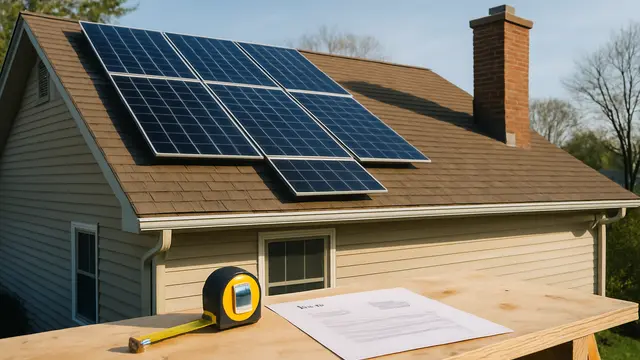
How much do solar panels cost in 2026? Real installed prices per watt from Berkeley Lab, costs by system size, battery add-ons, and why no federal credit now.

Are solar panels worth it in 2026 now the 30% tax credit is gone? See real payback math by state, the export credit effect and when solar doesn't pay.
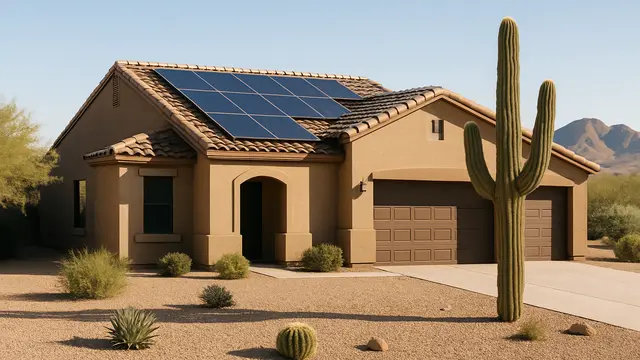
Solar panels in Arizona in 2026: APS, TEP and SRP export rates, the $1,000 state tax credit, property tax rules, HOA law and real savings math.
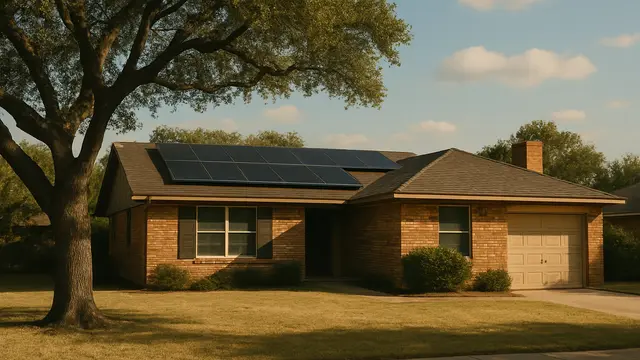
Are solar panels worth it in Texas? How buyback plans, Austin Energy and CPS rules, tax exemptions, HOA law and outages change your savings in 2026.