
California NEM 3.0 in 2026: How Net Billing Changes Solar Savings
California NEM 3.0 pays a few cents for exported solar. See how net billing, the 9-year lock-in and the new fixed charge shape savings in 2026.
What is net metering? Learn how utilities credit the solar power you export, how net billing differs, and how much each rule is worth on a typical home.
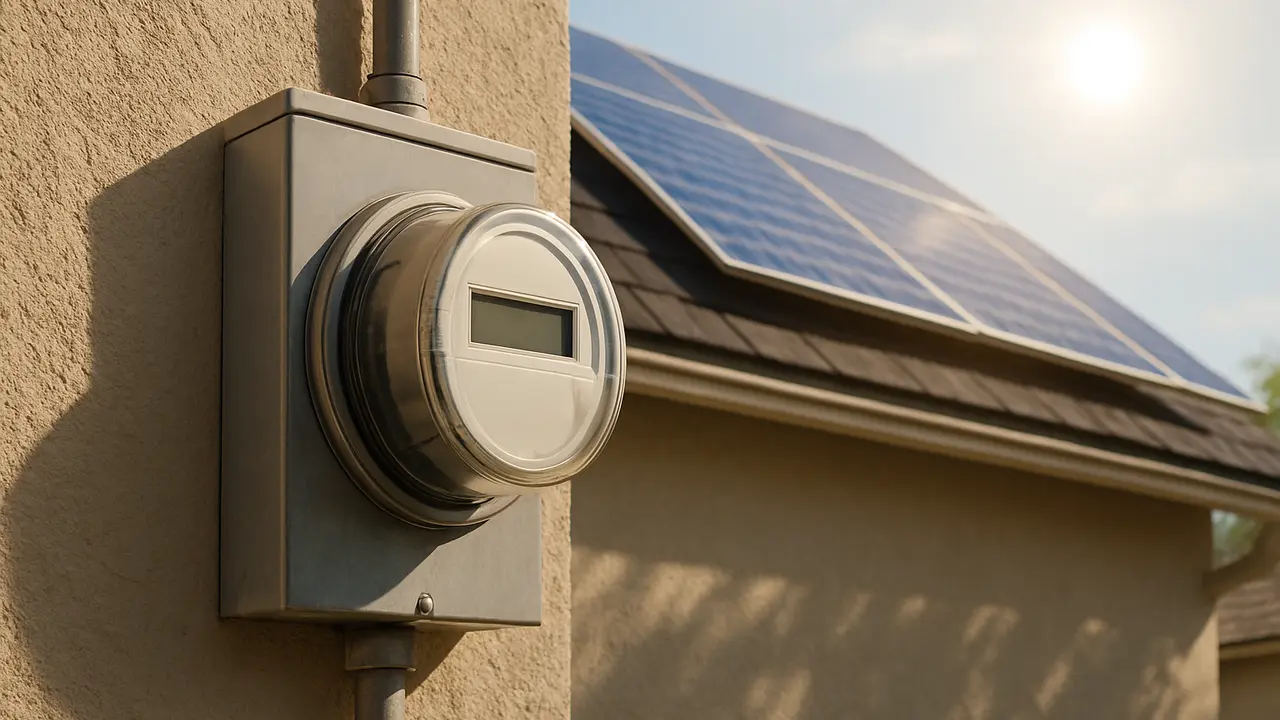
What is net metering? It is a billing rule that credits each kWh your solar panels send to the grid at the same retail rate you pay for electricity. Daytime surplus becomes a credit you use at night or in winter, so you pay only for your net use. Many utilities now pay less than retail for exports instead.
Whether your utility uses true net metering, net billing or something in between can change your solar savings by hundreds of dollars a year. This guide explains each method in plain terms, shows what they are worth on the same home, and covers what to ask your utility before you size a system.
Your utility measures power flowing both ways through your meter. When panels make more than the house uses, the extra flows to the grid and earns a credit. When the house uses more than the panels make, you draw from the grid and use those credits first. At the end of the billing period you pay for the net amount.
A typical day looks like this. Around midday, your panels may produce two or three times what the house needs, so the meter records exports. In the evening, your home draws power from the grid. Under full net metering, each exported kWh cancels one imported kWh, so the grid works like a free battery.
Most net metering programs also roll extra credits forward month to month. Summer surplus can cover part of a winter bill. Once a year, at the true-up, the utility settles any leftover credit, often at a lower rate than retail.
Under net metering, exports earn the full retail rate. Under net billing, the power you buy still costs retail, but exports earn a separate rate that is usually lower, often based on the utility's avoided cost. Solar you use at home as it is produced saves the full retail rate under either method.
There are several common designs:
How often your utility nets matters too. Monthly netting lets midday exports cancel evening use. Instantaneous or 15-minute netting counts almost every midday kWh as an export, which raises the share credited at the lower export rate.
On the same home, the export rule can nearly halve the value of solar. With 10,000 kWh of solar a year, 40% used at home and an 18.2 cent retail rate, the system is worth about $1,820 a year with full net metering, $1,547 at 75% of retail and $968 at a 4 cent export rate.
We used our net metering calculator with its defaults: 10,000 kWh of yearly production, 10,800 kWh of use, 40% self-use, and the EIA's 2026 forecast national residential price of 18.2 cents per kWh. The house uses 4,000 kWh of solar directly and exports 6,000 kWh.
| Export rule | Export credit | Value of home use | Value of exports | Yearly value | Average per solar kWh |
|---|---|---|---|---|---|
| Full retail net metering | 18.2¢ | $728 | $1,092 | $1,820 | 18.2¢ |
| 75% of retail | 13.65¢ | $728 | $819 | $1,547 | 15.5¢ |
| Avoided cost | 4¢ | $728 | $240 | $968 | 9.7¢ |
Notice what stays the same: the $728 from power used at home. Self-use is protected from export rule changes because it never touches the export credit. That's why self-use becomes the most important number when exports are cheap.
| Export rule | Home use (4,000 kWh) | Exports (6,000 kWh) |
|---|---|---|
| Full net metering | $728 | $1,092 |
| 75% of retail | $728 | $819 |
| Avoided cost (4¢) | $728 | $240 |
Source: Worked example: net metering calculator defaults, 40% self-use, EIA STEO 2026 forecast residential price of 18.2¢/kWh (as of 2026-10)
California's three big utilities moved new solar customers to the Net Billing Tariff for applications on or after April 15, 2023. Exports earn hourly avoided-cost values locked for nine years, power you buy is on a time-of-use rate, and the annual true-up remains. Solar-only exports average roughly 15% of retail.
The CPUC adopted the tariff in Decision D.22-12-056 (opens in a new tab). Export values come from the Avoided Cost Calculator and are low at midday and higher on summer evenings, when the grid needs power most. Customers who enroll in the first five years keep their export value schedule for nine years.
Because California rates are high, self-use is very valuable there. The EIA reports California's average residential price at 33.25 cents per kWh for January through July 2026. Using a 5 cent average export value, a 10,000 kWh system with 40% self-use is worth about $1,630 a year; at 60% self-use, about $2,195. Our California NEM 3.0 guide covers battery sizing and the ACC Plus adder in detail.
| 40% self-use | 60% self-use | |
|---|---|---|
| US average, 4¢ exports | $968 | $1,252 |
| California, 5¢ exports | $1,630 | $2,195 |
Source: Worked example: 10,000 kWh/yr; rates 18.2¢ (EIA forecast) and 33.25¢ (EIA California Jan–Jul 2026) (as of 2026-10)
Existing NEM 1 and NEM 2 customers keep their tariff for 20 years from interconnection, according to the CPUC's Q&A (opens in a new tab). If you are buying a home with solar, ask which tariff it is on and when the 20 years end.
Under full net metering, system size barely changes the value of each kWh, so sizing to your yearly use makes sense. Under a low export rate, every extra kWh beyond what you use in daytime earns little, so a smaller system sized closer to daytime use often pays back faster.
Here is a simple comparison at $3.00 per watt and 1,350 kWh per kW, for a home that uses 4,000 kWh of solar directly as it is produced. The simple payback below divides price by first-year value and ignores rate increases and panel aging, so it only shows the direction of the effect.
| System | Price | Yearly value, full net metering | Simple payback | Yearly value, 4¢ exports | Simple payback |
|---|---|---|---|---|---|
| 7.41 kW (10,000 kWh, covers yearly use) | $22,222 | $1,820 | 12.2 years | $968 | 23.0 years |
| 5.78 kW (7,800 kWh, smaller) | $17,333 | $1,420 | 12.2 years | $880 | 19.7 years |
With full credit, both sizes pay back in the same time, and the bigger system simply saves more. With 4 cent exports, the smaller system pays back more than three years sooner, because the extra 2,200 kWh the bigger system makes are almost all exported at low value. The best answer for many net billing homes is a smaller array, more daytime use or a battery.
| Full net metering | 4¢ exports | |
|---|---|---|
| 7.41 kW (covers yearly use) | 12.2 years | 23 years |
| 5.78 kW (smaller) | 12.2 years | 19.7 years |
Source: Worked example: $3.00/W, 1,350 kWh per kW, 4,000 kWh of direct self-use; price over first-year value (as of 2026-10)
Rarely. Solar credits offset energy charges, but most utilities also bill fixed monthly charges that credits can't touch. The FTC reminds solar buyers that they still pay utility fixed charges. In California, a new income-graduated fixed charge applies whether or not you have solar.
California's Base Services Charge is $24.15 a month for most customers, about $12 for FERA households and about $6 for CARE households. SCE and SDG&E began billing it in late 2025 and PG&E in March 2026, alongside lower per-kWh rates, according to PG&E (opens in a new tab). Lower per-kWh rates also make each solar kWh slightly less valuable.
Other utilities use minimum bills, grid-access fees or small monthly solar charges. Before you size a system, find your fixed charges on a current bill. The Federal Trade Commission's solar guide (opens in a new tab) also suggests asking about these costs before you sign.
Find your utility's net metering, net billing or distributed generation tariff on its website, or call and ask what a new customer would get today. Five questions cover most of what you need: the export rate, the netting interval, rollover rules, the true-up rate and any required rate plan.
Ask your utility:
Then use those answers in our solar savings calculator, setting the export credit as a share of retail. Our guide on solar incentives by state summarizes the main rules in major solar states.
Often, yes, but only if the numbers work. A battery stores midday surplus and uses it in the evening, turning low-value exports into full-value self-use. It pays most where exports are cheap and evening rates are high, as in California. Under full retail net metering, a battery rarely pays back on savings alone.
Under full net metering, the grid already gives you full credit for every exported kWh, so a battery adds backup power but little bill savings. Under net billing with time-of-use rates, each stored kWh can be worth the gap between the export credit and the evening price. Our guide to whether solar batteries are worth it runs those numbers, and our guide to whether solar panels are worth it shows how the export rule changes overall payback.
Net metering is a billing rule that lets your electric meter, in effect, run backward when your solar panels make more power than your home uses. Each exported kWh earns a credit at your retail rate, which you use later when the sun is down. You pay only for your net use over the billing period.
Under net metering, exports earn the full retail rate. Under net billing, exports earn a separate, usually lower, rate while the power you buy still costs retail. California's Net Billing Tariff, for example, credits exports at hourly avoided-cost values that change by month and time of day.
Usually not. Most utilities charge fixed monthly fees that solar credits can't cover. The FTC notes that solar owners still pay utility fixed charges. In California, the new income-graduated fixed charge is $24.15 a month for most customers, and export credits can't offset it.
It depends on the utility. Many roll unused credits from month to month and settle them once a year at a lower rate. Florida's investor-owned utilities, for example, pay leftover credit at avoided cost at the annual true-up. That's why systems are usually sized to your yearly use, not beyond it.
No. Rules vary by state and often by utility. Some states require retail-rate credit from investor-owned utilities, others have moved to net billing, and Texas has no statewide rule at all. Co-ops and city-owned utilities often set their own terms, so check your utility's solar tariff.
Sometimes, which is why grandfathering matters. California lets existing NEM 1 and NEM 2 customers keep their tariff for 20 years from interconnection, and its Net Billing Tariff locks export values for nine years for early enrollees. Nevada's terms are locked for 20 years. Ask your utility what lock-in applies to you.
It can be, but you need more self-use or a lower price. When exports earn little, solar you use directly is worth much more than solar you export. Running appliances in daytime, sizing the system to daytime use or adding a battery can raise the value of each solar kWh.
Look for a net metering, net billing or distributed generation tariff on your utility's website, or call and ask what a new customer would receive per exported kWh. Ask whether the rate changes by time of day, how often it is netted and what happens to leftover credits.

California NEM 3.0 pays a few cents for exported solar. See how net billing, the 9-year lock-in and the new fixed charge shape savings in 2026.

Are solar panels worth it in 2026 now the 30% tax credit is gone? See real payback math by state, the export credit effect and when solar doesn't pay.

Solar incentives by state for 2026: state tax credits, property tax exemptions, rebates, SRECs and the export rules that matter most now that 25D is gone.

Are solar batteries worth it? See 2026 battery costs, when time-of-use savings and backup pay off, and why the answer differs in CA, AZ and TX.